The Ultimate Guide to Ryukin
What a Ryukin Actually Is
The Ryukin is one of the oldest established fancy goldfish varieties and one of the most structurally distinctive.
It isn’t built for length or elegance.
It’s built for depth, muscle and presence.
A proper Ryukin isn’t just a round goldfish with a tail.
It’s a deep-bodied fish with a pronounced shoulder hump, strong peduncle and a balanced, powerful outline.
When it’s right, it looks like the heavyweight class of the goldfish world.
Why Ryukin Standards Matter
Ryukin are often misunderstood because young fish — and most shop fish — don’t show their final shape.
Without a proper hump, a fish simply reads as a fantail.
Many never develop beyond that.
Judging a Ryukin isn’t about colour or finnage first.
It starts with body structure.
Everything else sits on top of that.
What This Guide Covers
This isn’t a beginner’s overview or a breed description copied from a standard.
It’s a practical guide built from tanks, tubs, shows and judging tables in the UK hobby.
We’ll look at:
• What defines a real Ryukin
• How body shape develops
• What faults actually matter
• How judging priorities work in practice
• What breeders and keepers should watch for
The Core Ryukin Structure
1. The Shoulder Hump
The hump is the defining feature of the Ryukin.
It should:
- rise clearly behind the head
- peak before the dorsal fin
- flow smoothly into the back
- give the fish a strong “shouldered” look
It must never look like a sudden lump or deformity.
The best fish show a powerful rise that still looks natural.
A weak hump makes the fish read as a fantail.
An exaggerated hump without balance makes the fish look unstable.
2. Body Depth
A Ryukin should be deep through the body, not round.
You’re looking for:
- depth behind the head
- thickness through the mid-body
- a solid, muscular outline
The body should feel substantial rather than balloon-like.
Too shallow and it loses presence.
Too round and it loses structure.
3. The Peduncle
The peduncle (tail base) is hugely important and often overlooked.
It should be:
- thick
- strong
- able to support the tail without drooping
A thin peduncle weakens the entire fish visually.
Good Ryukin look as if the tail grows out of strength, not softness.
4. The Head
The head should be:
- slightly pointed
- proportionate to the body
- forward-facing in stance
It should never look blunt or overly rounded.
A clean head helps emphasise the shoulder rise behind it.
Finnage and Balance
Tail
The tail should be:
- well divided
- open when the fish swims
- proportionate to the body
It shouldn’t be so long it dominates the fish.
Nor should it be tight or folded.
The best tails look powerful but controlled.
Dorsal Fin
A Ryukin should carry a strong dorsal.
It should:
- stand upright
- be clearly defined
- follow the body line naturally
A weak dorsal ruins the silhouette.
Pectoral, Pelvic and Anal Fins
These should be:
- even
- correctly placed
- proportional
They’re rarely the headline feature, but imbalance here shows immediately in movement.
Colour and Scale Type
Colour comes after structure.
A perfectly coloured fish with poor shape is still a poor Ryukin.
A structurally strong fish with average colour can still be excellent.
Common colour forms include:
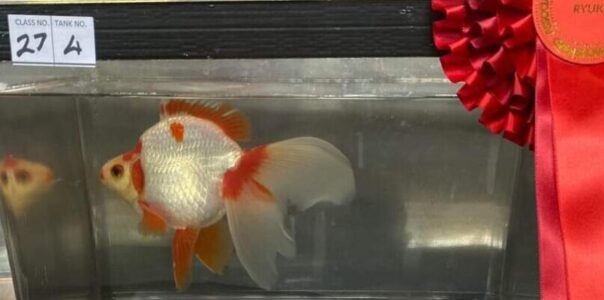
• Red & white
• Metallic red
• Calico
• Nacreous types
Scale quality matters more than pattern perfection.
Clean scales and good skin quality always show.
How Ryukin Develop Over Time
Young Ryukin rarely show their final form.
The hump develops gradually as:
- body depth increases
- muscle builds
- the back line strengthens
Fish that look plain at 6 months can become outstanding adults.
Likewise, some promising young fish flatten out as they grow.
Development is slow, and judging too early is a common mistake.
Common Faults in Ryukin
Weak or Flat Back
This makes the fish look like a fantail.
Balloon Body Without Structure
Round isn’t the goal.
Depth and strength are.
Thin Peduncle
A weak tail base spoils the whole outline.
Oversized Tail
A tail that dominates the fish throws off balance.
Head Too Blunt or Too Small
This affects the entire shoulder profile.
How Ryukin Are Judged in Practice
In theory, judging follows written standards.
In reality, experienced judges tend to look in this order:
- Body structure
- Shoulder profile
- Balance of outline
- Movement in the tank
- Finnage quality
- Colour and finish
A fish that looks powerful and balanced from across the room already has an advantage.